SHENZHEN, GUANGDONG, CHINA, October 29, 2026 /EINPresswire.com/ — Heavy-Duty Calibration Guide: Tips From a Professional 6 Spring Pilates Reformer Manufacturer In China
Commercial Pilates studios face mounting operational demands for equipment consistency as daily class schedules expand across international fitness markets. High-volume studio usage places continuous physical stress on reformer carriages, structural frames, and spring tension assemblies. Over extended periods, subtle resistance variations jeopardize movement control, strain client muscles, and diminish overall workout effectiveness. Consequently, studio operators require technical calibration protocols to maintain mechanical balance and ensure practitioner safety during intensive group sessions. Partnering with a knowledgeable Professional 6 Spring Pilates Reformer Manufacturer In China provides commercial facilities with essential engineering insights into heavy-duty hardware maintenance. Systematically inspecting and calibrating resistance components preserves equipment longevity, stabilizes operational expenditure, and safeguards client satisfaction. Commercial fitness directors must prioritize routine mechanical audits to ensure every reformer delivers predictable tension, smooth carriage movement, and structural reliability under heavy dynamic weight loads.
The Mechanics of Resistance Decay: Why Precision Spring Calibration Defines Studio Safety
Continuous mechanical tension causes gradual metal fatigue within reformer springs during high-intensity group classes. Although individual springs appear visually intact to the naked eye, internal crystalline changes reduce structural elasticity over extended operational periods. Consequently, compromised springs exert asymmetrical pull across the carriage bed, shifting movement alignment away from the central axis. This subtle mechanical imbalance forces practitioners to compensate with improper movement mechanics, which increases injury risks during repetitive exercise routines.
Biomechanical misalignment directly compromises core engagement and places unexpected shear stress on spinal joints during footwork, hip extension, and arm series. Furthermore, asymmetric spring tension creates uneven lateral friction along the frame rails, causing premature track wear and irregular carriage drag. When instructors cannot trust tension predictability across different machines, class instruction quality becomes inconsistent across the studio floor. Regular calibration protocols prevent these hidden operational hazards before structural fatigue causes total spring failure or movement distortion. Facility managers who establish standardized inspection schedules protect client safety, enhance instructional precision, and extend hardware life cycles across busy commercial studio environments.
Navigating the 6-Spring, 3-Row Hook Matrix: Biomechanical Customization for Every Body Type
Standard four-spring or five-spring reformer setups often lack the nuanced tension versatility required in modern commercial fitness environments. In contrast, a six-spring configuration expands the available resistance spectrum, allowing precise load customization for diverse client body weights and physical conditioning levels. Combining six distinct spring values enables instructors to fine-tune resistance increments for rehabilitation clients, general fitness enthusiasts, and high-performance athletes alike.
Furthermore, integrating a three-row hook gearbar amplifies this mechanical flexibility by offering three distinct anchorage heights for spring attachments. Adjusting the hook row alters the initial spring stretch and modifies the resistance curve throughout the entire carriage stroke. Positioned at lower anchorages, springs deliver gentle initial resistance ideal for delicate spinal articulation and restorative routines. Conversely, higher hook rows increase preload tension for explosive lower-body movements and heavy strength loading. This multi-tier architecture integrates seamlessly across versatile equipment formats, including classic outer-track reformers, the wooden Pilates Reformer Tower machine (Model FM01-1), and outer-track tower hybrid systems (Model X-FM02-2). Consequently, studio owners achieve maximum operational versatility and tailored biomechanical resistance from a single equipment investment.
Material Science in Heavy-Duty Hardware: RINTELN’s 1.2-Million Cycle Fatigue Benchmark
Selecting high-grade raw materials determines whether commercial reformer springs maintain consistent elasticity or suffer rapid tension loss under heavy daily usage. Low-grade spring steel deforms permanently under repeated stretching cycles, forcing facility owners into frequent, expensive component replacements and unexpected class cancellations. To eliminate resistance decay in commercial environments, RINTELN (Shenzhen Ruiteng Sports Technology Co., LTD) engineers high-performance tension assemblies utilizing premium steel wire imported directly from Germany.
This specialized German steel alloy possesses exceptional tensile strength and superior elastic memory, resisting structural sagging despite heavy multi-client utilization. Moreover, RINTELN subjects every spring model to rigorous laboratory endurance testing before commercial deployment. Factory quality control testing subjects these six-spring assemblies to 1,200,000 continuous fatigue cycles under maximum dynamic load conditions. Throughout this exhaustive trial, the springs maintain their original coil length, tensile force, and axial alignment without structural degradation or material cracking. Consequently, commercial facilities equipped by RINTELN experience reliable resistance performance, reduced maintenance interventions, and predictable operational overhead across multi-year commercial usage schedules.
The Commercial Maintenance Checklist: 4 Practical Steps for Heavy-Load Reformer Inspections
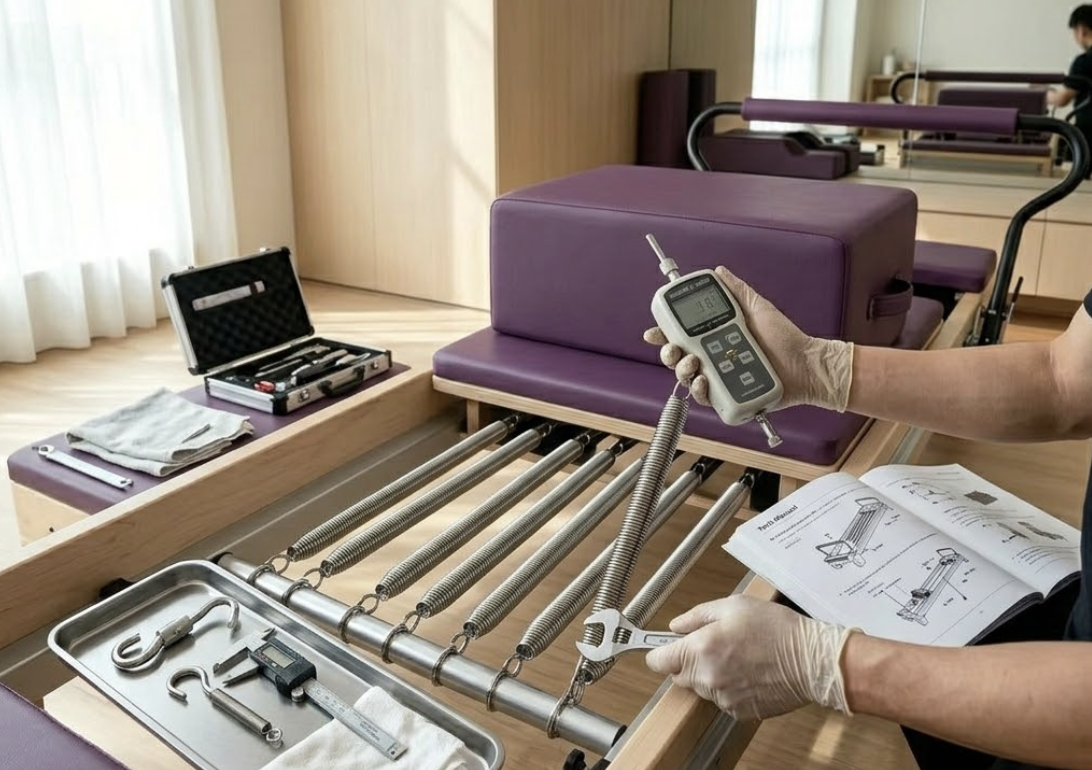
Maintaining peak mechanical performance requires a structured, step-by-step inspection routine tailored for heavy-use commercial equipment. Studio technicians should execute these four diagnostic steps monthly to guarantee optimal machine function:
Step 1: Tensile Balance and Coaxial Inspection: Unhook all six springs and check for uniform recoil speed and resting length alignment. Inspect spring coils for micro-gaps, uneven stretching, or surface discoloration that signals internal metal fatigue.
Step 2: Hook and Gearbar Wear Audit: Examine the three-row hook assembly for notch marks, metal shavings, or friction wear. Ensure attachment hooks settle securely into gearbar slots without slipping under heavy tension loads.
Step 3: Outer Track Alignment and Torque Verification: Inspect rail mounting bolts using a calibrated torque wrench to ensure structural stability. Verify frame squareness and outer track alignment to prevent carriage drag or lateral rail wobble under maximum spring resistance.
Step 4: Tower and Pulley System Calibration: For combination apparatus like Model FM01-1 and Model X-FM02-2, inspect overhead push-through bars, safety straps, and swivel pulleys. Verify rope length alignment and check upright frame attachments for structural rigidity under dynamic pulling angles.
Beyond Manufacturing: Securing Long-Term Equipment Performance with RINTELN
Commercial fitness success depends on reliable hardware that withstands the rigorous demands of continuous daily studio operations. Partnering with a specialized equipment manufacturer allows facility owners to secure long-term operational efficiency and professional technical support. Shenzhen Ruiteng Sports Technology Co., LTD combines advanced metal fabrication, strict quality control protocols, and comprehensive engineering support to deliver heavy-duty Pilates apparatus globally.
Furthermore, RINTELN provides complete OEM and ODM manufacturing capabilities, enabling studio franchises and international distributors to customize equipment configurations to specific market requirements. By maintaining comprehensive inventory for replacement springs, gearbar hooks, and structural components, the company ensures minimal operational downtime for commercial clients. Investing in precision-engineered hardware protects facility reputation, enhances user safety, and drives long-term business profitability across competitive fitness markets.
For detailed technical specifications, product manuals, and commercial procurement inquiries, please visit the official company website: www.szruiteng.com.
RINTELN
RINTELN
Legal Disclaimer:
EIN Presswire provides this news content “as is” without warranty of any kind. We do not accept any responsibility or liability
for the accuracy, content, images, videos, licenses, completeness, legality, or reliability of the information contained in this
article. If you have any complaints or copyright issues related to this article, kindly contact the author above.

Media gallery