Vadzo’s Bolt-900MGS is a 3MP Monochrome Global Shutter MIPI Camera built on the Sony Pregius S IMX900 Sensor. It combines simultaneous pixel exposure with Quad HDR up to 120 dB, Quad Shutter Control, and native NIR response in a board-level module that streams over 2 Lane & 4 Lane MIPI CSI-2 directly into the host SoC. OEM engineering teams building high-speed inspection, robotics, AGV navigation, and biometric platforms get motion distortion, scene contrast, and low illumination addressed as one hardware problem instead of three separate software corrections.
IRVINE, CA / ACCESS Newswire / September 4, 2026 / Vadzo Imaging is a global leader in embedded vision camera products for OEM and system integrator programs. The company today announced the Bolt-900MGS. The Bolt-900MGS is an IMX900 Global Shutter MIPI Camera built for engineering teams that need geometrically accurate monochrome capture in scenes where subject motion, extreme contrast, and invisible illumination occur at the same time. The module delivers 3MP output at 2064×1552 with 2.25 μm pixels over a 2 Lane & 4 Lane MIPI CSI-2 interface. It connects directly to embedded AI SoC platforms in a compact board-level footprint without USB enumeration overhead or a network stack in the data path.
The Engineering Problem: Three Failure Modes That Appear in the Same Frame
Embedded vision systems that observe moving subjects under uncontrolled lighting fail in three distinct ways. Those failures rarely appear in isolation. They compound inside the same frame, and they defeat corrections applied downstream in the inference pipeline.
The first failure is geometric. A rolling shutter sensor exposes and reads out pixel rows in sequence. Relative motion between the sensor and the subject during that readout window shifts the scene between the first row and the last. The result is skew on vertical edges and elongation on objects crossing the field of view. A conveyor running at 2 m/s or an AGV turning under load produces distortion that is not cosmetic. It corrupts the edge geometry that dimensional measurement, structured light triangulation, and pose estimation all depend on. Simultaneous exposure removes the failure at the point of capture rather than approximating a correction afterward.
The second failure is photometric. Industrial and outdoor scenes present a contrast range far wider than a standard dynamic range sensor can encode in a single exposure. A specular highlight on a machined surface saturates while the shadowed cavity beside it sits below the noise floor. Automatic exposure control cannot resolve the conflict because it can only select which half of the scene to lose. Frame stacking is not a usable alternative when the subject is in motion because the merge step reintroduces exactly the artifacts a global shutter sensor was selected to eliminate.
The third failure is spectral. Applications that depend on invisible illumination at 850 nm or 940 nm lose a substantial fraction of that signal to the Bayer color filter array. Every pixel under a color filter receives only the portion of incident flux that its filter passes. Raising illuminator output to compensate increases the thermal and power budget of the whole platform and shortens emitter service life.
Accepting one failure in order to solve another is the trade-off embedded engineering teams have historically made. The Bolt-900MGS removes that compromise at the sensor level.
Engineering Explanation: How Global Shutter, Quad Shutter Control, and Quad HDR Work Together
Global shutter operation depends on a storage node inside every pixel. Charge accumulates across the entire array during a single exposure window and transfers to that storage node at the same instant for every pixel. Readout then proceeds row by row from storage rather than from the photodiode. Nothing in the scene can change between the first row and the last because the exposure has already ended. The Sony Pregius S IMX900 Sensor implements this in a back-illuminated stacked architecture. Back illumination places the wiring layer behind the photodiode so incident photons reach the silicon without obstruction. The stacked design moves supporting logic onto a separate die and returns that area to light collection.
Quad Shutter Control extends the architecture by allowing four exposure conditions to be captured under independent shutter timing inside a single capture sequence. Each of the four is a full-array global shutter exposure. The short condition preserves highlight detail that a single long exposure would saturate. The long condition recovers shadow detail that a single short exposure would bury in read noise. Because all four use simultaneous exposure, the sensor avoids the temporal misalignment that makes conventional exposure bracketing unusable on a moving subject. A Quad Shutter Control Camera therefore gives the system designer exposure headroom without surrendering geometric accuracy.
Quad HDR is the output of that process. The sensor combines the four exposure conditions into a single high dynamic range frame with a range extending up to 120 dB. The host receives one coherent frame rather than a burst that application software must align and merge. That distinction matters in an embedded pipeline where every additional processing stage adds latency to the control loop and consumes SoC cycles the inference model needs.
Monochrome imaging completes the design. Removing the color filter array gives each pixel unobstructed access to the full photon flux across the visible and near-infrared spectrum. The result is a higher signal-to-noise ratio at equivalent illumination and usable response at the 850 nm and 940 nm wavelengths that industrial and biometric illuminators operate at. Vadzo applies the same reasoning across its global shutter range and publishes a comparable AR0234 global shutter MIPI camera guide for teams evaluating an Onsemi Global Shutter Image Sensor against the Sony part.
Sensor and Camera Overview
The Bolt-900MGS is built on the Sony Pregius S IMX900. The sensor is a 1/3.1″ stacked CMOS global shutter device with a 2.25 μm x 2.25 μm pixel pitch and a native resolution of 3MP at 2064×1552. As an IMX900 Monochrome Global Shutter MIPI Camera, the module ships without a Bayer mosaic, so per-pixel sensitivity is maximized across the visible and NIR bands. The Sony IMX900 Image Sensor delivers Quad HDR up to 120 dB and Quad Shutter Control from the same stacked pixel architecture that provides the global shutter readout.
Configured as an IMX900 MIPI Camera, the module connects over 2 Lane & 4 Lane MIPI CSI-2 directly to the host SoC ISP. Full 3MP output is supported alongside subsampled and windowed region-of-interest streaming for higher frame rate operation on bandwidth-constrained platforms. The Sony Pregius S IMX900 MIPI Camera accepts standard S-Mount (M12) optics and operates across −40°C to 85°C. The mechanical footprint is 38 mm (L) x 38 mm (B) and is convertible to 32 mm (L) x 32 mm (B) for space-constrained OEM layouts. Module-level drivers ship out of the box for Raspberry Pi 4, Raspberry Pi 5, Jetson Orin NX, Jetson Orin Nano, Jetson Xavier NX, and NXP i.MX8M Plus.
The Bolt-900MGS sits inside Vadzo’s embedded MIPI CSI-2 camera portfolio alongside global shutter and rolling shutter options at other resolution points. Teams that require the same sensor over a USB interface can specify the equivalent Falcon series module without altering the optical or illumination design. Specified as a 3MP Monochrome Global Shutter Camera, the module carries the same sensor, optics interface, and thermal range across both interface options.
Key specs: Sony Pregius S IMX900 | 3MP (2064×1552) | Global Shutter | Sensor Format 1/3.1″ | Pixel Size 2.25 μm x 2.25 μm | 2 Lane & 4 Lane MIPI CSI-2 | Quad HDR up to 120 dB | Quad Shutter Control | NIR Sensitivity | S-Mount (M12) | −40°C to 85°C | 38 mm (L) x 38 mm (B) convertible to 32 mm (L) x 32 mm (B)
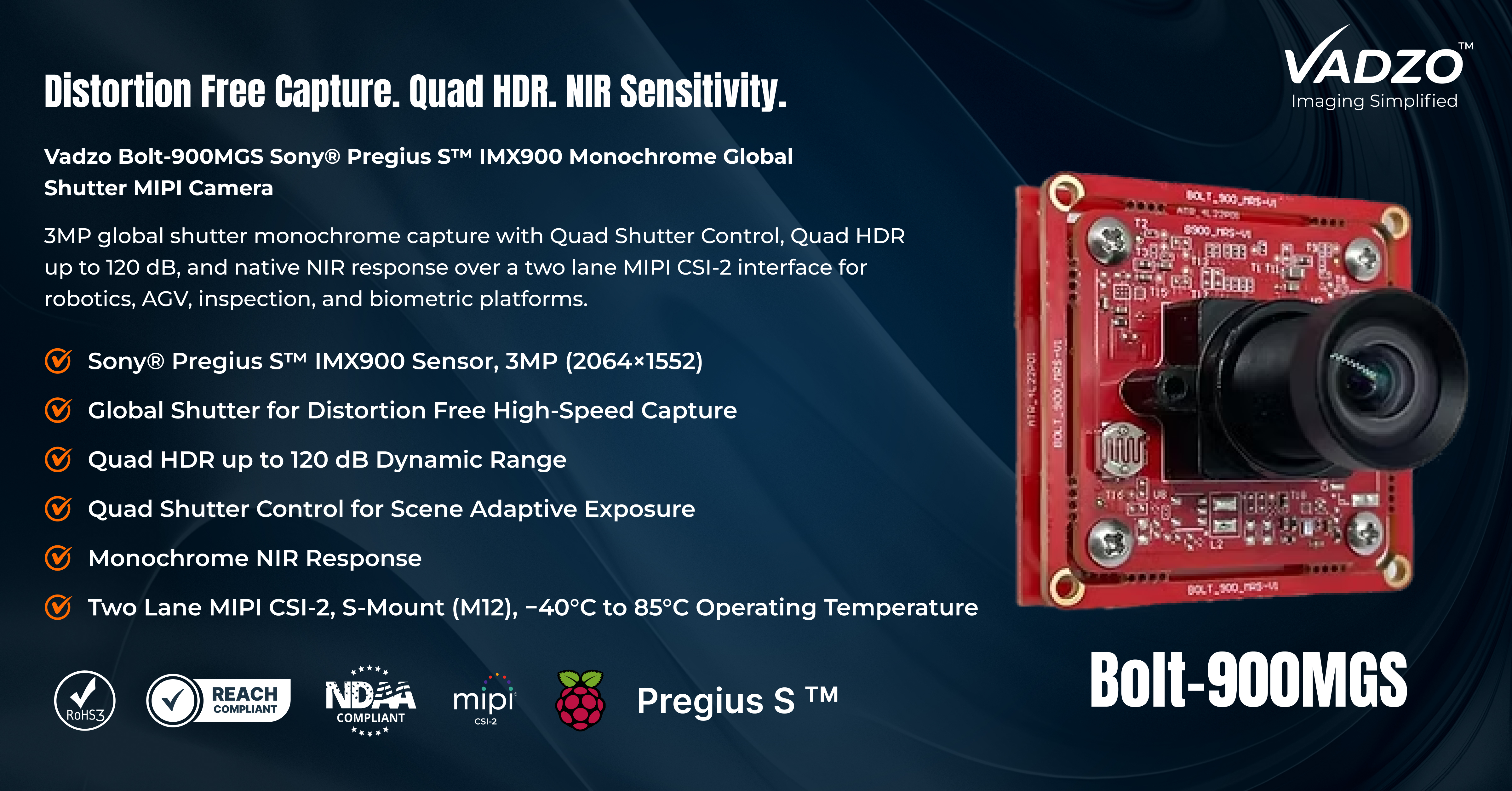
Key Capabilities of the Bolt-900MGS IMX900 Global Shutter MIPI Camera
Global Shutter Precision for Distortion-Free High-Speed Capture: The Bolt-900MGS captures all 3MP pixels in the same exposure window on every frame. Spatial distortion is eliminated where it originates instead of being estimated afterward by software. The module functions as a Distortion-Free High-Speed Camera in applications where the subject and the sensor are both in motion. That is the normal operating condition on packaging lines, in robotic pick-and-place cells, and on AGV platforms running at speed. Geometric fidelity becomes a hardware guarantee in this architecture rather than a statistical correction, and the difference shows up directly in measurement repeatability and in classification confidence at feature boundaries. Vadzo covers the underlying physics in more depth in its reference material on the High Speed Global Shutter Camera.
Quad Shutter Control for Scene Adaptive Exposure Management: Quad Shutter Control gives the sensor four independent exposure conditions inside a single capture sequence. Each condition is applied to the full array under global shutter timing. The practical benefit is that a scene containing a bright reflective surface and a deeply shadowed recess can be captured correctly without the host attempting to select a compromise exposure. The Bolt-900MGS also gives integrators a route to handle transient illumination such as strobe-fired inspection stations and pulsed NIR illuminators without retuning automatic exposure between frames. Exposure headroom of this kind reduces the number of rejected frames in a production inspection loop and reduces how often a line has to be recalibrated after its lighting is changed.
Quad HDR up to 120 dB for Extreme Contrast Scenes: The IMX900 Quad HDR MIPI Camera combines four exposure conditions into a single frame with dynamic range extending to 120 dB. A 3MP Quad HDR MIPI Camera of this type delivers usable detail in the highlights and in the shadows at the same time, and nothing in the host application has to align or merge a burst. As a Quad HDR Global Shutter Camera, the Bolt-900MGS applies wherever an outdoor scene, a welding cell, a backlit doorway, or an illuminated tunnel entrance places both extremes in the same field of view. Removing the merge stage also removes the latency and the SoC load that frame stacking imposes on an embedded inference pipeline.
NIR Sensitivity for Invisible Illumination Imaging: Removing the color filter array makes the Bolt-900MGS an IMX900 NIR Monochrome Camera with usable response at 850 nm and 940 nm. Systems can therefore operate under invisible illumination without adding visible light to the environment. That matters in overnight surveillance infrastructure, in occupant monitoring, and in inspection stations where operators work beside the imaging cell. As an IMX900 NIR MIPI Camera, the module supports structured light projection, laser line profiling, and vein or iris capture under IR illuminators. A 3MP NIR MIPI Camera with global shutter timing also holds a projected pattern geometrically stable through the exposure. Accurate triangulation depends on exactly that stability. Vadzo examines the two sensor classes directly in its analysis of NIR imaging against RGB imaging in industrial vision.
2 Lane & 4 Lane MIPI CSI-2 and Board Level OEM Integration: The module streams over a MIPI CSI-2 interface directly into the host SoC ISP. Frame timing stays deterministic because there is no USB enumeration layer, no host-side driver stack, and no network buffering between the sensor and the processor. A 3MP Global Shutter MIPI Camera operating on two lanes fits inside the bandwidth budget of SoC designs that cannot allocate four CSI-2 lanes to one sensor. Physically, the Bolt-900MGS is one of Vadzo’s board-level camera modules for embedded and machine vision systems and drops into an OEM PCB layout without mechanical redesign. The S-Mount (M12) interface accepts alternative focal lengths and field-of-view options without a board change.
Product Specifications
|
Parameter |
Specification |
|
Product Model |
Bolt-900MGS |
|
Camera Type |
IMX900 Monochrome Global Shutter MIPI Camera |
|
Image Sensor |
Sony® Pregius S™ IMX900 |
|
Sensor Format |
1/3.1″ |
|
Resolution |
3MP (2064 x 1552) |
|
Pixel Size |
2.25 μm x 2.25 μm |
|
Shutter Type |
Global Shutter |
|
Color Format |
Monochrome |
|
Dynamic Range |
Quad HDR up to 120 dB |
|
Exposure Control |
Quad Shutter Control |
|
Spectral Response |
Visible and NIR |
|
Interface |
2 Lane & 4 Lane MIPI CSI-2 |
|
Lens Mount |
S-Mount (M12) |
|
Operating Temperature |
−40°C to 85°C |
|
Module Dimensions |
38 mm (L) x 38 mm (B) convertible to 32 mm (L) x 32 mm (B) |
|
Supported Platforms |
Raspberry Pi 4, Raspberry Pi 5, Jetson Orin NX, Jetson Orin Nano, Jetson Xavier NX, NXP i.MX8M Plus |
|
Compliance |
RoHS3, REACH, NDAA |
“Engineering teams have been forced to pick two out of three for a long time. Global shutter accuracy, dynamic range, or NIR sensitivity. The Sony Pregius S IMX900 lets us deliver all three in one board-level module. Quad Shutter Control is the part that changes the design conversation. Four global shutter exposures inside one capture sequence means a customer can hold geometry and recover a 120 dB scene at the same time. For a robotics or inspection team building on Jetson or Raspberry Pi, this removes an entire layer of software compensation from the pipeline and gives back SoC cycles for the inference model.” – Alwin Vincent, Product Manager, Vadzo Imaging.
Target Applications
Industrial Inspection and High-Speed Machine Vision: Surface defect detection, dimensional measurement, and code reading on moving product all require that the frame reaching the decode or measurement engine be geometrically true. The Bolt-900MGS operates as a High Speed Machine Vision Camera in these cells because simultaneous exposure holds the geometry at conveyor speed and Quad HDR holds detail across specular and shadowed regions of a machined or coated part. The 2.25 μm pixel pitch supports the ground sample distance calculation engineers run before lens selection. NIR response allows structured infrared illumination to be used without disturbing the visible lighting that human operators depend on. Deployed as a Factory Automation Vision Camera, the module also suits robot-guided assembly verification and inline gauging. Vadzo maintains a broader technical review of the global shutter camera series used in industrial automation.
Robotics, AGV, and Autonomous Material Handling: Localization, obstacle detection, and path planning degrade quickly when frame geometry shifts with platform velocity. As a Robotics Vision MIPI Camera, the Bolt-900MGS delivers frames that stay dimensionally consistent through acceleration, braking, and turning. Low-latency delivery over MIPI CSI-2 keeps the perception stage inside the timing budget of a real-time control loop. Deployed as an AGV Navigation MIPI Camera, it supports floor marker tracking, pallet pocket detection, and docking alignment in warehouse environments where overhead lighting and daylight ingress vary across a shift. Vadzo covers the reasoning in its material on motion artifact-free imaging in high-speed robotics and in its automation and robotics solutions.
Biometrics, Access Control, and Security Infrastructure: Iris recognition, vein pattern capture, and face liveness detection are built on NIR illumination and on precise spatial geometry. A monochrome global shutter sensor satisfies both requirements at once. Enrollment and matching reliability depend on the absence of skew during capture. As a 3MP Monochrome Camera with NIR response, the Bolt-900MGS supports these pipelines under 850 nm and 940 nm illuminators with no visible light in the scene. The module also fits perimeter and entrance deployments across security and surveillance installations and identity verification terminals in kiosk and digital signage systems where subjects cross the field of view at walking pace.
Medical Device and Laboratory Instrumentation: Diagnostic instrumentation, pathology scanners, and surgical guidance platforms weight spatial accuracy and tonal fidelity above color information. A 3MP Monochrome MIPI Camera delivers both in a footprint suited to portable and cart-mounted equipment. Quad HDR handles the contrast between a brightly illuminated sample region and the surrounding field without saturating either. NIR response extends the module into fluorescence and multispectral imaging modalities. Vadzo supports these programs through its medical device and patient care engagements, including custom optical filter integration, lens holder modification, and enclosure design for cleanable instrument housings.
Traffic, Smart City, and Fleet Telematics: Automatic license plate recognition, tolling, and intersection analytics operate under headlight glare, low sun angles, and unlit night conditions inside the same 24-hour cycle. Quad HDR up to 120 dB keeps a plate legible while the vehicle headlamp is in frame. Global shutter timing prevents the plate geometry from shearing at highway speed. The module suits smart city solutions infrastructure and both in-cabin and forward-facing roles in telematics and fleet management platforms. Operators applying the same capability to checkout monitoring and shelf analytics can reference Vadzo’s retail automation solutions.
Platform Support and V4L2 Driver Integration
Every Bolt series module ships with a Linux kernel driver package and platform-specific device tree overlays. The IMX900 Monochrome MIPI Camera is validated on Raspberry Pi 4, Raspberry Pi 5, Jetson Orin NX, Jetson Orin Nano, Jetson Xavier NX, and NXP i.MX8M Plus. Integration follows the standard V4L2 subdev model. The sensor subdevice exposes source pads that link to the CSI-2 receiver sink pads and then through the SoC ISP entities to the V4L2 video node. Pad format has to be set at every link boundary rather than only at the video device, and a format applied at the video node alone produces a successful stream with zero-filled buffers.
Vadzo supplies media controller configuration scripts alongside the overlays so lane count, lane polarity, and pad format start from a confirmed reference instead of trial and error. Engineers new to the platform can follow the Vadzo MIPI camera integration guide and the walkthrough covering MIPI camera streaming on Raspberry Pi 5. Teams standardizing on Raspberry Pi hardware can review the Raspberry Pi 5 MIPI CSI-2 camera resources. Teams building on NVIDIA hardware can review the NVIDIA Jetson MIPI CSI-2 camera module documentation and the wider edge AI camera solutions material. Driver porting for additional NXP i.MX, STM, and MediaTek targets is available on request from the Vadzo engineering team.
Frequently Asked Questions
Q: What is the difference between a global shutter MIPI camera and a rolling shutter module for high-speed capture?
A: A rolling shutter sensor exposes and reads pixel rows in sequence, so the top of the frame and the bottom of the frame represent the scene at different instants. Anything moving during that window is recorded with skew or elongation. A global shutter sensor exposes every pixel simultaneously and transfers charge to an in-pixel storage node before readout begins, which means the frame is a single coherent sample of the scene. The practical consequence is that dimensional measurement, barcode decoding, and pose estimation stay valid at operating speed rather than only when the line is stopped. Vadzo’s Bolt-900MGS is a 3MP Monochrome Global Shutter MIPI Camera built on the Sony Pregius S IMX900 for precisely this class of work, and the company explains the underlying mechanism in its article on global shutter imaging accuracy.
Q: How does Quad Shutter Control differ from conventional HDR bracketing on a moving subject?
A: Conventional bracketing captures several sequential frames at different exposure settings and merges them in software. Any subject or platform motion between those frames produces ghosting and edge doubling in the merged result, which is why bracketing is generally unusable in robotics and inspection. Quad Shutter Control applies four exposure conditions under independent shutter timing inside one capture sequence, and each condition is a full array global shutter exposure. The sensor outputs a single combined frame with dynamic range up to 120 dB rather than a burst that the host has to align. Vadzo implements this on the Bolt-900MGS, so embedded teams can hold geometric accuracy and recover a high-contrast scene without adding a merge stage to the pipeline.
Q: Why does monochrome sensor architecture improve NIR imaging compared with a color variant?
A: A color sensor places a Bayer filter mosaic over the pixel array so each pixel receives only the wavelengths its filter passes. That filter absorbs a large share of incident light, including much of the near-infrared band. An IMX900 Monochrome Camera has no filter layer, so the full photon flux reaches every photodiode across the visible and NIR spectrum. At the 850 nm and 940 nm wavelengths used by biometric and covert surveillance illuminators, the difference in signal-to-noise ratio against a color sensor of equivalent pixel pitch is substantial. That gap determines whether an identification system works at night without visible lighting. Vadzo compares the two approaches in detail in its material on NIR versus RGB sensitivity in industrial vision and on monochrome sensor architecture.
Q: Which SoC platforms support a 3MP global shutter MIPI CSI-2 module and what driver work is required?
A: Module-level Linux kernel drivers and device tree overlays are provided for Raspberry Pi 4, Raspberry Pi 5, NVIDIA Jetson Orin NX, Jetson Orin Nano, Jetson Xavier NX, and NXP i.MX8M Plus. These cover the primary embedded Linux targets used in production robotics, edge AI, and industrial deployment. The integration work that remains is normally limited to confirming lane count and lane polarity in the device tree endpoint and propagating pad format through the media controller chain. Vadzo ships reference scripts for both steps with the Bolt-900MGS and provides driver porting for additional NXP i.MX, STM, and MediaTek targets on request. Teams standardizing on NVIDIA hardware can start from the Vadzo Jetson camera module resources.
Q: What pixel pitch and resolution should an engineer target for high-speed inspection at a given working distance?
A: The governing quantity is ground sample distance, calculated as pixel pitch multiplied by working distance and divided by focal length. Feature detection normally needs at least two pixels across the smallest feature of interest. A 2.25 μm pixel at 500 mm working distance behind a 25 mm lens yields roughly 0.045 mm per pixel, which maps a 0.1 mm feature onto slightly more than two pixels. Shortening the working distance or lengthening the focal length adds margin. Finer pixel pitch buys spatial resolution at a fixed focal length, while a larger pixel buys depth of field tolerance and per-pixel sensitivity.
Availability and Customization
The Bolt-900MGS is available now for evaluation and OEM integration as a 3MP MIPI Camera within the Vadzo Bolt series. Evaluation units can be ordered through the Vadzo online store or configured with the applications engineering team. Teams sourcing a 3MP Monochrome Global Shutter MIPI Camera for a production program can request full mechanical and electrical documentation before design-in. The IMX900 Monochrome Global Shutter Camera is listed with current pricing and lead time.
Vadzo supports full OEM customization on the Sony Pregius S 3MP MIPI Camera platform including form factor modification and board redesign, firmware development and custom feature integration, NIR and visible LED illumination board design, sensor integration for ToF, mmWave radar, and IMU, lens holder modification and electromechanical filter control, and enclosure design in IP rated and non-IP rated configurations. Buyers evaluating alternatives across the range can buy a 3MP Monochrome MIPI Camera online. Technical questions can be routed to the applications team through contact support.
About Vadzo Imaging
Vadzo Imaging develops embedded and machine vision camera products for OEMs and system integrators building production-ready vision systems across industrial automation, robotics, healthcare, and smart infrastructure. Vadzo Imaging’s portfolio spans MIPI CSI-2, USB, GigE, Wi-Fi, and SerDes interfaces, supporting a wide range of embedded deployment architectures. Vadzo provides end-to-end imaging support including sensor integration, ISP tuning, firmware development, and SDK frameworks that shorten system deployment timelines. Learn more at www.vadzoimaging.com.
Media Contact
Alwin Vincent
Vadzo Imaging
Email: alwin@vadzoimaging.com
LinkedIn: Vadzo Imaging
YouTube: Vadzo Imaging
X: Vadzo Imaging
SOURCE: Vadzo Imaging
View the original press release on ACCESS Newswire
Media gallery